
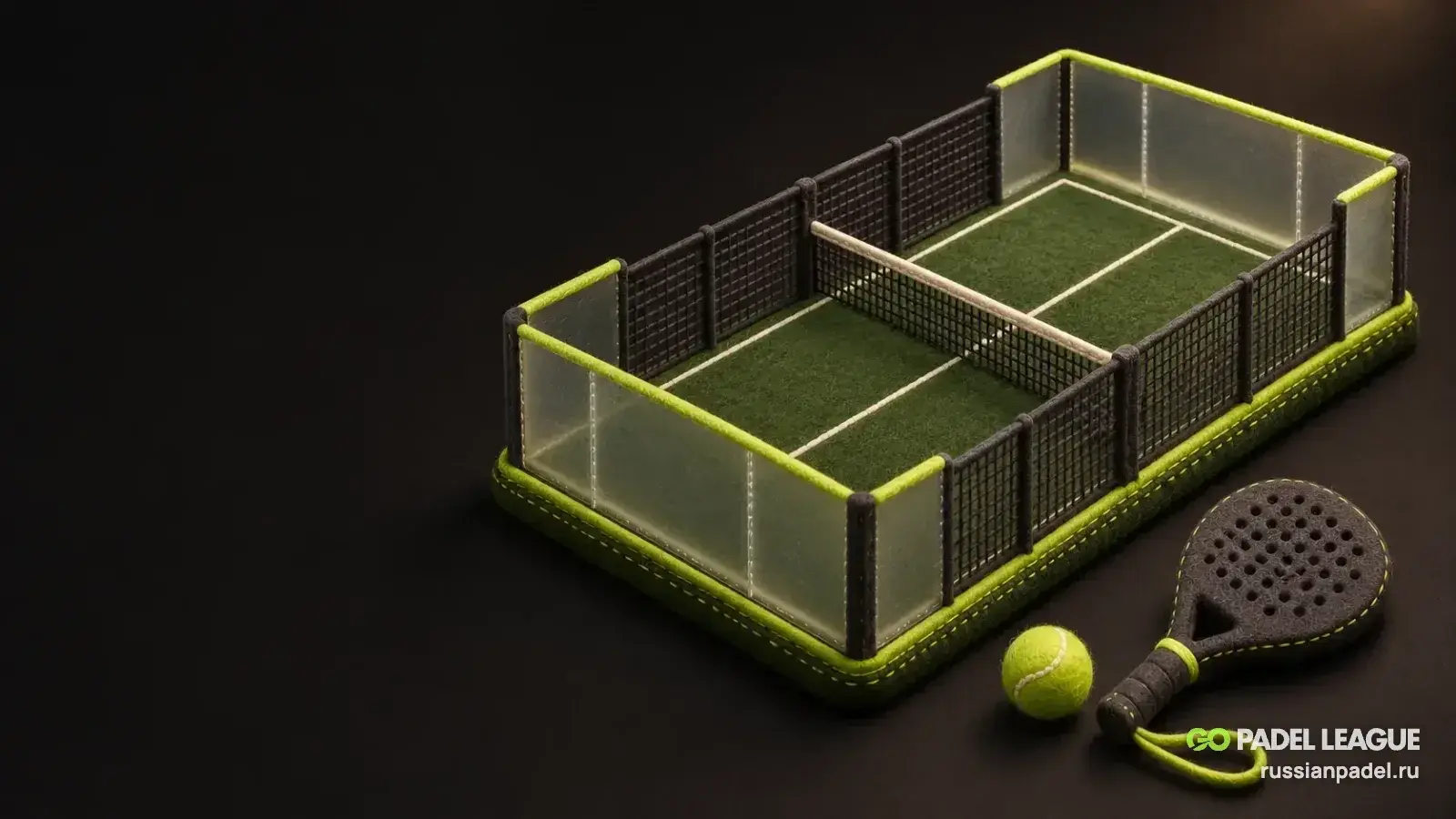
Padel is…
Padel is a sport of its own, not a variant of tennis. It borrows scoring and the net from tennis and the walls from squash. The court is smaller than a tennis court and the racket is shorter and has no strings, so beginners get long rallies from their very first game. In Spanish it is spelled pádel; you may also see “padel tennis”.
The court
A padel court is a 10 × 20 m rectangle split by a net. The back walls and the first metres of the side walls are glass; the rest is metal mesh. The walls are part of the game: the ball bounces off the glass and stays in play.
A rally on the diagram
Pick a scenario and the ball will fly across the court. The buttons below highlight parts of the court.
The dashed line shows a typical rally: a diagonal serve, a bounce on the floor, a bounce off the back glass and a return.
Tap a name to highlight it on the diagram.
The service lines are 6.95 m from the net. The net is 88 cm high in the centre and 92 cm at the posts. The surface is usually artificial grass with sand, so the ball bounces evenly and a little slower than on a hard court.
Padel rules in brief
If you have played tennis, half the rules will feel familiar. The big difference is the walls.
- Serve. The server drops the ball behind the service line and, after it bounces, hits it diagonally into the opponents’ service box. Contact must be at or below waist height. You get two attempts if the first one is a fault.
- Return of serve. Wait for the first bounce. After bouncing, the ball may touch the glass. If it hits the metal mesh before the second bounce, the serve is a fault.
- Playing off the glass. If the ball bounces on your side and then hits the back glass, you still have time to return it before it bounces again. You can also play the ball against your own wall, as long as it then lands in the opponents’ court.
- Floor first. On the opponents’ side the ball must touch the floor first. If it hits their glass or mesh without bouncing, you lose the point.
- Volleys. During a rally you can hit the ball before it touches the floor. On the return of serve, the ball must bounce.
- Scoring. A classic match uses 15, 30, 40, game; social rounds often just count points. How scoring works
How padel is scored
Match play. Within a game the score goes 0, 15, 30, 40. Winning a fourth point wins the game, as long as the opponents have two points at most. At 40–40 the score is “deuce”. With advantage scoring, a pair must win two points in a row. If the rules use a golden point, the next point decides the game. Since 2026 some FIP and Premier Padel events use the Star Point: if the score returns to deuce twice after an advantage, the next point decides the game. A set is usually played to six games with a two-game margin, with a tie-break at 6–6.
Social rounds by points. In Americano, Mexicano and other club formats players often just count 1, 2, 3 and so on. Every rally won gives the pair one point. The organiser sets the total number of rallies for both pairs, for example 16, 19 or 24. With a limit of 16, a score of 10–6 ends the round; with 19, a score of 10–9 does. Who serves when and how ties are resolved depend on the event rules.
Try keeping score
Choose a format and award a point to either pair.
0–0. Award a point to either pair to start.
Advantage game: 0 → 15 → 30 → 40. In a round by points every rally is worth one point. Examples: 10–6 with 16 rallies, 10–9 with 19.
| Score | Total | What happens |
|---|---|---|
| 10–6 | 16 | 16-rally round finished, pair A wins |
| 8–8 | 16 | A tie — the event rules decide what happens |
| 10–9 | 19 | 19-rally round finished, pair A wins |
Sources: FIP Rule 1 · sample Americano rules
Where padel came from
From Acapulco to world tours
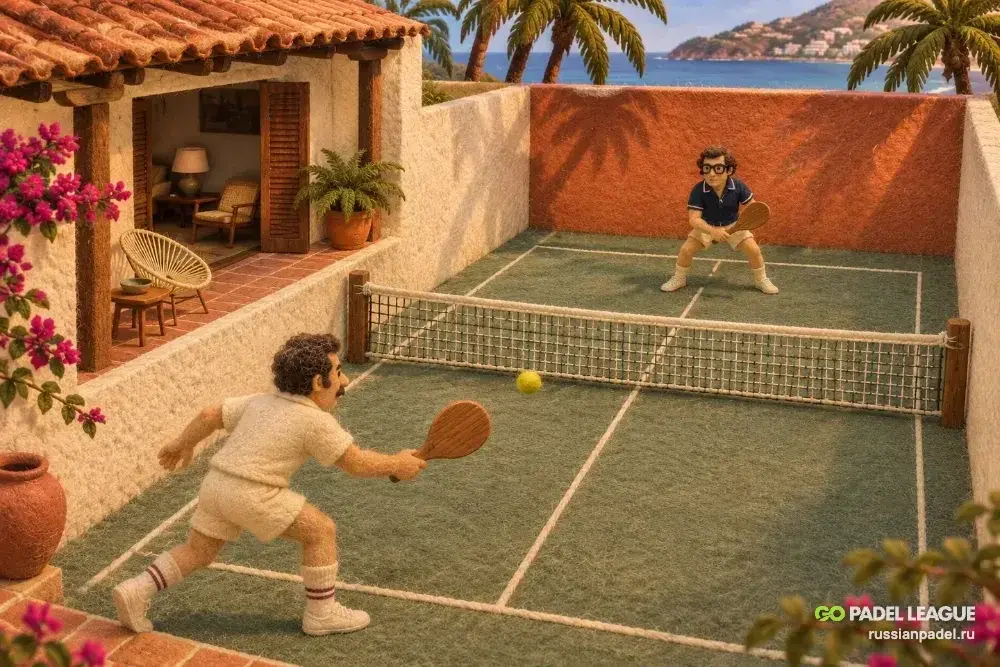
A court in the backyard
Enrique Corcuera lived in Las Brisas, a neighbourhood of Acapulco. There was not enough room in his yard for a full tennis court, so he built a 10 × 20 m one, put up walls and strung a net across the middle. Bounces off the walls became part of the game.
His wife Viviana wrote down the first rules and gave them to Enrique as a birthday present.
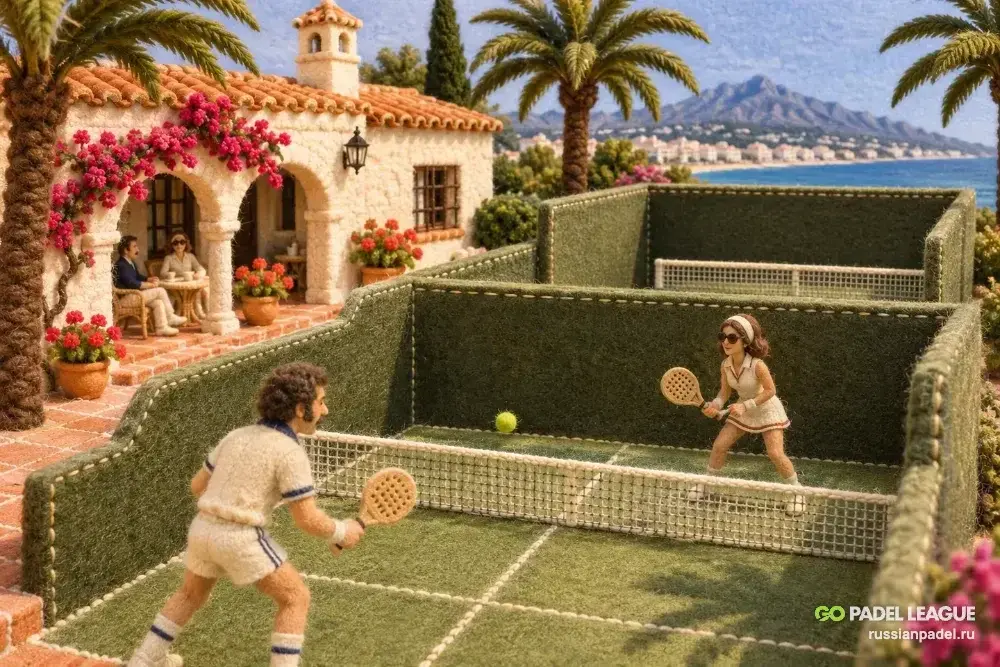
From Acapulco to Marbella
Prince Alfonso de Hohenlohe discovered padel as Corcuera’s guest. Back in Spain he built courts at the Marbella Club on the Andalusian coast. There the game caught the eye of Argentine Julio Menditeguy, who took it home.
A glass court you can move
Club Tortugas and the Mar del Plata Ocean Club were among the first Argentine venues. In the 1980s padel spread to other countries in the Americas and Europe.
In 1989 Argentine coach Jorge Galeotti designed Crystal Palace, a detachable glass court. It could be transported and rebuilt at a new venue, and spectators could watch the rally through the glass.
From the first World Championship to millions of players
In 1991 the federations of Argentina, Spain and Uruguay founded the International Padel Federation (FIP). A year later Madrid and Seville hosted the first World Championship. In 1997 Spain and Argentina agreed on common rules and on the name “padel”.
According to FIP, there are padel courts in about 150 countries and 20 territories. Player counts vary: FIP says 40 million, while market studies estimate around 20 million regular players.
Sources: FIP history · FIP World Padel Report 2026
Padel has been growing fast in Russia over the last few years: new clubs keep opening, tournaments count towards the Russian Padel Federation rating, and amateur leagues have appeared, such as GoPadel League. You can start with an open game, a lesson or an amateur tournament — see the options for Moscow and Yaroslavl below.
Racket and ball
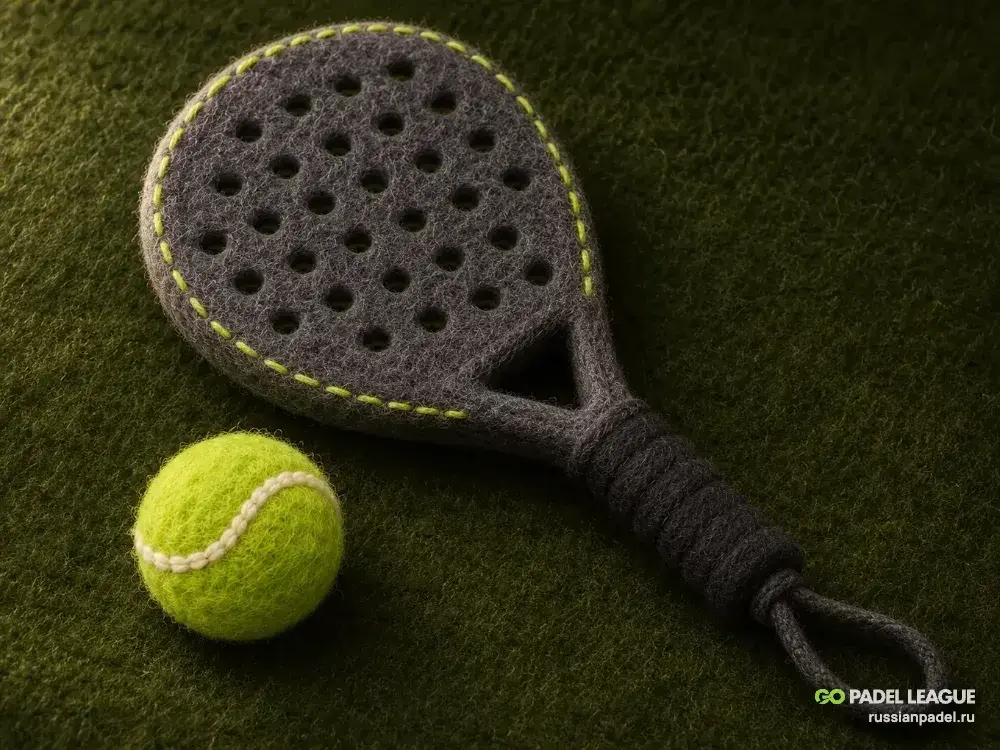
A padel racket has a solid, perforated face with no strings and a short handle. Inside is a foam core, outside carbon or fibreglass. It may be no longer than 45.5 cm and no thicker than 38 mm.
The handle has a wrist strap — a cord you put on before playing so the racket doesn’t fly out of your hand.
The ball looks like a tennis ball but has slightly lower pressure, so it bounces lower and slower and rallies last longer.
No need to buy a racket straight away — clubs rent them out for your first sessions.
Source: FIP racket requirements
Padel vs tennis
| Padel | Tennis | |
|---|---|---|
| Court | 10 × 20 m, with walls | 10.97 × 23.77 m (doubles), no walls |
| Players | usually 2 vs 2 | 1 vs 1 or 2 vs 2 |
| Serve | underarm, after a bounce | usually overhead |
| Racket | stringless, perforated, short | strung, longer |
| Walls | part of the game | none |
Source: ITF Rules of Tennis
Why padel is fun
A second chance
The walls give the ball a second life. If it is flying deep, you can let it hit the glass and return it after the bounce.
Team tactics
Partners agree who takes balls down the middle, when to move up to the net and when to drop back.
A social game
There are always four people on court, partners rotate, and players usually stay to chat afterwards.
Would the serve count?
Three situations on the return of serve. Think it over, then reveal the answer.
The ball lands diagonally in the opponents’ service box and then hits the back glass.
Show answer
Good serve. Hitting the glass after bouncing in the box is fine — the receiver returns it before the second bounce.
The ball lands in the box and then hits the metal mesh before the second bounce.
Show answer
Fault. On the serve, the ball must not hit the metal mesh after the bounce.
The first bounce is outside the service box.
Show answer
Fault. The ball must first land in the opponents’ diagonal service box. The server still has a second attempt.
Where to play padel in Moscow and Yaroslavl
Pick a city and a trial session. In an hour a coach will show you the grip, the serve and how to play off the walls.
Rent the gear. Rackets and balls are available at the club.
Play with people at your level — at an open game or an amateur tournament.
Moscow has dozens of padel clubs. Most club staff and players speak Russian, so it helps to message the organiser before your first game.
FAQ
Is padel a type of tennis?
No, it is a separate sport with its own rules and federations. It is sometimes called “padel tennis”, but the court, racket, serve and use of the walls are all different from tennis.
Padel or paddle — what’s the difference?
Padel (from Spanish pádel) is the sport described here. Paddle tennis and platform tennis are different American games with their own courts and rules.
Is padel hard to learn?
Beginners pick up the basic shots in one or two sessions and get proper rallies in their first game. Tennis or squash experience helps but isn’t required.
Do I need my own racket?
Not for your first games — clubs rent rackets. It’s better to choose your own once you know your style of play.
How long does a game last?
For a first game you can book a court for 60–90 minutes. Match length depends on the format and the number of rallies. Check the booking time and rules with the organiser.
What does a 16-point round mean?
It is a club format: the two pairs play 16 rallies in total and each rally is worth one point, for example 10–6. Try it on the scoreboard above.
Can two people play?
Yes: there are narrow courts for singles, and two people can practise on a standard court. But classic padel and almost all tournaments are doubles.
Where can I play padel in Moscow?
Moscow has dozens of padel clubs. The PadelPlay community runs open games for different levels, and GoPadel League holds amateur tournaments at several Moscow clubs. In Yaroslavl there is the GoPadel club at 78 Oktyabrya Avenue with six panoramic courts, coaching and tournaments.
Play your first tournament with GoPadel League
Leave a request — the league manager will find a lesson or tournament at your level and help you find a partner.
I want to play →